The capital planning review is in one hour.
A vacation club manager spent the last three weeks implementing a new capital planning platform. The promise was straightforward — automated funding recommendations across their entire resort portfolio, generated in minutes rather than days. No more inconsistent reserve studies. Technology doing what technology is supposed to do.
The report is on the screen. Clean funding model. Confident numbers.
The reserve specialist leans in and starts reading.
The component useful life assumptions do not look right. Not dramatically wrong — wrong in the way that only someone who has assessed these specific asset types many times would notice. The cost escalation models are pulling generic indices that do not reflect what high-value resort equipment actually costs to replace. The funding scenarios look reasonable on a screen but would not hold up under scrutiny from an experienced professional.
The specialist now has two jobs. The actual reserve planning work. And a new job no one planned for — reviewing every platform output, identifying the errors, and correcting what the reserve management software got wrong.
Six months later the platform is abandoned. The team returns to spreadsheets.
I have watched this pattern across cybersecurity, cloud infrastructure, and enterprise SaaS for more than twenty years. The technology changes. The cause is always the same.
The Problem Was Never the Technology
When a software implementation fails, the instinct is to look at the technology. Wrong platform. Wrong features. Wrong vendor.
In my experience, that is rarely where the real failure lives.
The vacation club platform was not poorly engineered. It was built by capable people who understood software. What it lacked was genuine understanding of the work it was designed to support — the specific asset types, the methodology, the professional judgment that sits behind every defensible reserve plan.
That gap between technical capability and domain knowledge is the most common and most costly failure mode in enterprise software. I have seen it in cybersecurity products that generated confident threat assessments without understanding the specific environments they were monitoring. I have seen it in cloud infrastructure tools that optimized for metrics that looked right on a dashboard but did not reflect how the underlying systems actually performed under load.
Now I see it in reserve planning software that defaults to generic item descriptions instead of letting reserve management firms write their own. It looks like a small feature. It is not. It is the difference between a reserve study a firm can stand behind and a study that merely has their name on it — the detail that lets a firm say, this one is ours.
The pattern is consistent. Engineers who are excellent at building software, working without sufficient understanding of the problem they are solving. The result is a product that impresses in a demo and frustrates in production.
Reserve planning is not a simple domain to build for. It is a professional judgment problem — one where the data, the methodology, the assumptions, and the output all have to cohere in a way that a reserve specialist can stand behind and defend. A platform that does not understand that from the ground up will not just fall short. It will actively make the work harder.
What I Learned Building Software That Cannot Afford to Fail
Before EZRS, I led product and Go-to-market at Malwarebytes, Acronis, Arcserve, and Strato. In cybersecurity particularly, the standard for software reliability is unforgiving. A tool that generates false confidence does not just frustrate users — it creates exposure. An organization that trusts a platform’s automated assessment and acts on it without scrutiny can find itself more vulnerable than if it had no tool at all.
That experience shaped how I think about every product decision I make.
Automated recommendations that are confidently wrong are not a minor inconvenience. They are a trust-destroying failure that is harder to recover from than no automation at all. The vacation club operator who returned to spreadsheets did not just lose an implementation budget. They lost the institutional willingness to try again.
The lesson I carried from cybersecurity into reserve planning is this: if your software is going to support a professional recommendation, it has to be built on a foundation that understands the work deeply enough to earn that role. Not approximately. Not for a generic use case. For the specific asset, the specific portfolio, the specific context a reserve specialist is working in.
That is a high bar. It is the only bar worth setting.
Why Artificial Intelligence (AI) in Reserve Planning Has to Be Built Differently
The failure of that vacation club platform was not an AI failure. It was a domain knowledge failure that automation made more visible and more damaging.
General-purpose AI tools are powerful. They are not a substitute for understanding the specific problem they are being applied to. Reserve planning is not a document generation problem or a data retrieval problem. It is a professional judgment problem — one where the specialist’s expertise is not an input to be replaced but the foundation the entire output rests on.
That means the AI we are building at EZRS is not designed to generate reserve studies or replace the specialist’s judgment. It is designed to remove the friction that prevents the specialist from applying their judgment where it actually matters.
AI that handles the repeatable — so the specialist can focus on the irreplaceable.
Here is what that division of labor actually looks like:
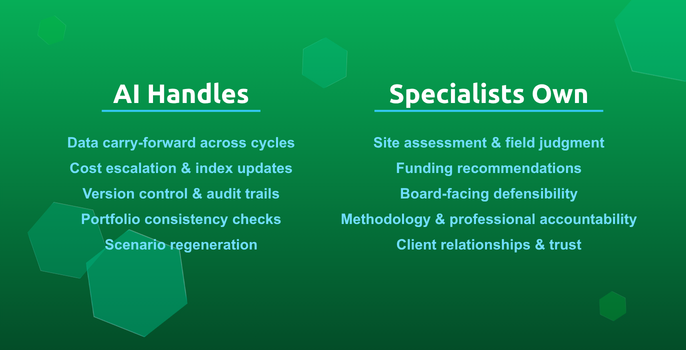
The automated recommendation that eroded trust at that vacation club was sitting in the wrong column. It was attempting to own something that belongs to the specialist — without the domain knowledge to do it correctly.
That is the line we will not cross.
Why Industry Knowledge and Engineering Depth Have to Be Built Together
I hold multiple patent applications in AI and machine learning. I have built products at enterprise scale across complex international environments. None of that is sufficient on its own to build reserve planning software that works.
EZRS’s reserve planning software has a 36-year body of methodology behind it. What we are building on — developed in deep partnership with PRA — represents decades of field-tested practice. That is not a data source we are consuming. It is a foundation we are building from.
36-years supporting the industry. 36-years adapting to it. 36-years perfecting alongside it. Every lesson learned earned its place in the software. That is what makes it worthy of the industry it serves.
The engineering challenge is to honor that methodology in the software architecture itself. The way EZRS’s AI reserve planning software generates component lifecycles, funding models, and depreciation curves has to reflect how reserve specialists actually think about those problems — not how they are easiest to model computationally.
When we make a product decision, we are not asking “what is the cleanest technical approach?” We are asking “does this fit the way a reserve specialist actually works, and does it make that work more defensible?”
One report for one master association is the clean technical approach. It is also the wrong one. Sub-associations need their own defensible report — not a subset of someone else’s, not an appendix, their own. Presentation and organization are not finishing touches here. They are what makes the technology disappear into the reserve management workflow instead of fighting it.
Those are harder questions. They take longer to answer. They are the only questions worth asking if the goal is software that professionals will trust — and keep trusting after the demo is over.
Building Back the Trust That Bad Software Eroded
The vacation club operator who returned to spreadsheets is not an edge case. Across the reserve planning industry there is a layer of earned skepticism toward technology that has walked in before, promised transformation, and delivered frustration.
That skepticism is not an obstacle to work around. It is a standard to be held to.
Every industry that has successfully integrated technology into complex professional workflows has done so by building tools that made the professional more capable — not tools that attempted to replace the judgment that defines the quality of the work. Legal research software did not replace lawyers. Financial modeling platforms did not replace analysts. The tools that earned lasting trust were the ones that understood the work deeply enough to support it without distorting it.
That is the standard we are building to at EZRS.
My job is to make sure what we build is worthy of the trust the industry places in it. Not just in the demo. In production. Every cycle. Across every portfolio it touches.
What Good Reserve Planning Software Should Actually Do
Good reserve planning software does not try to think for the specialist. It tries to think like the work demands — and then gets out of the way.
That means reserve studies built on assumptions a specialist would actually defend, not assumptions that were merely easy to compute. It means funding models that reflect how a portfolio actually ages, not a generic curve borrowed from a different industry. It means lifecycle planning that holds up when someone with thirty years in the field starts asking why.
The software disappears into reserve management workflows instead of sitting on top of them, demanding to be reconciled, corrected, justified after the fact. That is the only version of automation worth building. Not software that replaces judgment. Software that earns the right to support it.
That is the standard this entire piece has been arguing for. It is also the easiest standard to claim and the hardest one to actually meet.
Want to hold us accountable?
If you are a reserve planning professional who has been burned by software that overpromised and underdelivered, I would welcome the conversation. We are building this differently — and we would rather be told where we are wrong now than find out in production later.
Book a 30-minute discovery call at ezrs.com/contact
About Easy Reserve Study (EZRS)
Easy Reserve Study® (EZRS®) is AI-augmented reserve study software for smarter capital planning. Built for reserve management companies, independent reserve specialists, property managers, HOAs, vacation clubs, and institutional operators — EZRS replaces static spreadsheets and fragile manual processes with a continuously updated, living system of record.
We are building in active partnership with the reserve planning industry. If you are a reserve professional curious about what we are working on, we would welcome the conversation.