



I didn’t want the industry adapting to EZRS. So, I brought together engineers I’ve worked with for years, across cloud, security, and enterprise software — people who know how to build a product that fits an industry instead of asking the industry to fit it.
That team built the software behind EZRS and added AI to handle the repetitive tasks, so a reserve professional’s judgment can shine. After years leading technology and cloud businesses, I spent time working inside the reserve study industry itself — and learned that a product can look right on paper and still miss how reserve professionals actually work. The only way to know for sure is to hand it to someone doing the job and watch closely.
That’s the gap EZRS was built to close. Real properties, real pressure, real feedback, in the middle of building the product rather than after — that’s exactly what private beta was built to deliver. Here’s what we learned.
Aligning Our Reserve Study Software to the Standard the Industry Already Trusts
Structure came up consistently in nearly every private beta conversation. We’d built EZRS around a framework that made sense to us — private beta showed us it wasn’t the format the industry already trusted. Asking reserve professionals to relearn terminology outside the standard wasn’t solving a problem. It was creating one.
Through companies participating in private beta, we learned the standard is the National Reserve Study Standards (NRSS) , built by reserve study providers themselves and formalized in 1998 by the Community Associations Institute (CAI), an international nonprofit representing and supporting condo, homeowners association (HOA), and co-op communities by providing education and standardization.
NRSS gives every study the same terminology — so “% Funded” means the same thing no matter who wrote the report — and the same expected content: a defined reporting period, 20 years of income and expense detail, a reliable component list, and standardized details like useful life and replacement cost.
So, we rebuilt EZRS around NRSS. Every component carries the standard fields, every % Funded calculation follows its definition, and every report covers the ground it expected. Worth calling out: that consistency is what lets a board, lender, or new management company trust a report on sight, without decoding it first. We matched the industry. We didn’t ask the industry to match us.
Real Reserve Fund Data Is Messy — Categories Had to Keep Up
NRSS gave every study a common framework. But structure was only half the story — the next thing private beta surfaced was how data gets organized day to day.
EZRS organized everything through properties, and that’s still the foundation. But capital planning and reserve companies pointed out something we’d missed: a property-level view alone doesn’t reflect how professionals actually think about the components inside it.
A reserve professional managing a large portfolio thinks in systems — pool equipment on one property, agricultural equipment on another, HVAC across a dozen buildings, all needing to be tracked the same way. Without a way to categorize items independent of property, that view meant exporting data and rebuilding it elsewhere, every time.
So we added dedicated item categorization to EZRS. A reserve professional can now group components by type — pool-related items, agricultural equipment, any category a portfolio calls for — not just by property. Someone managing dozens of properties can see every pool pump or every piece of agricultural equipment across their whole portfolio in one place, without leaving the platform.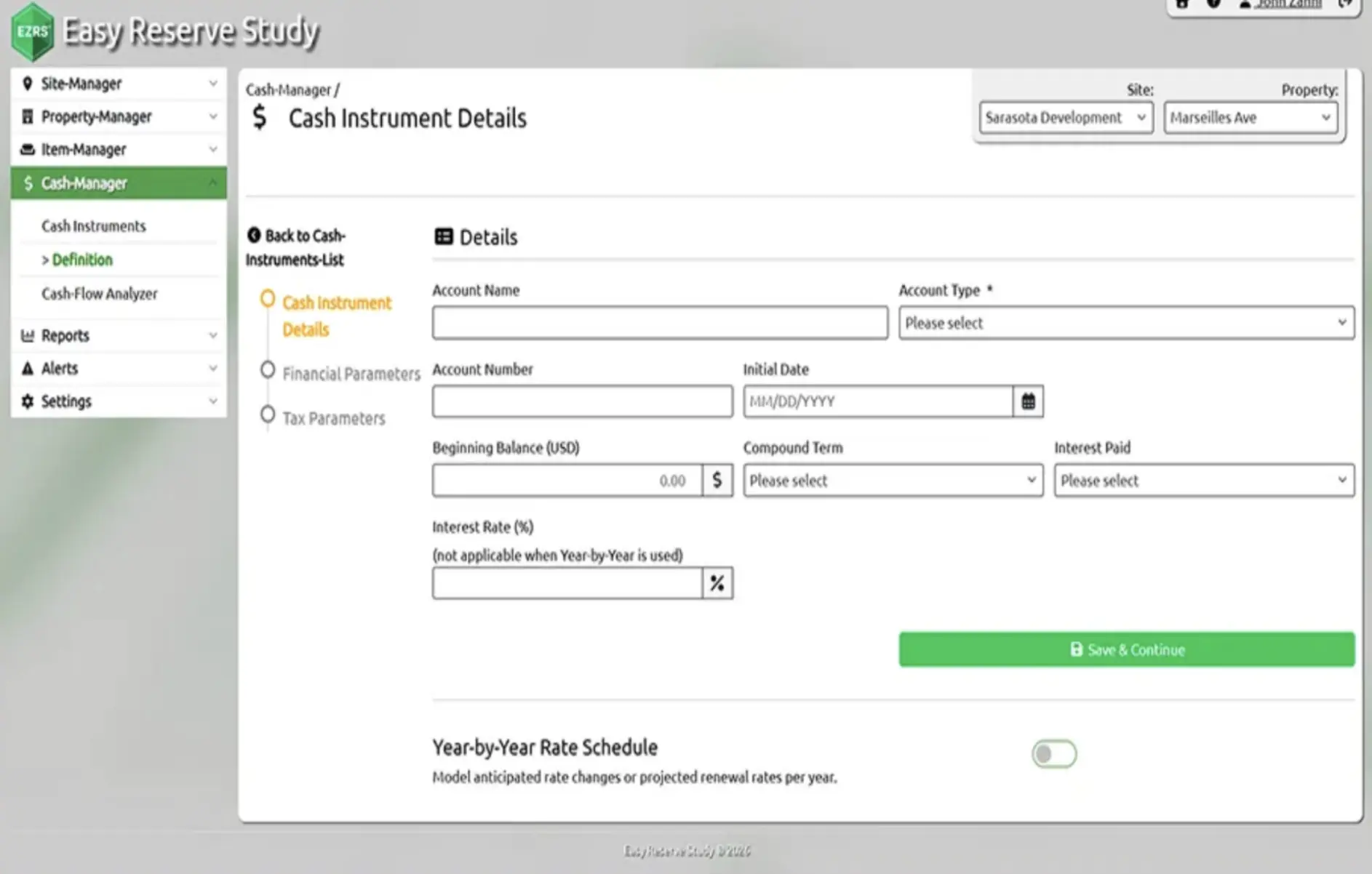
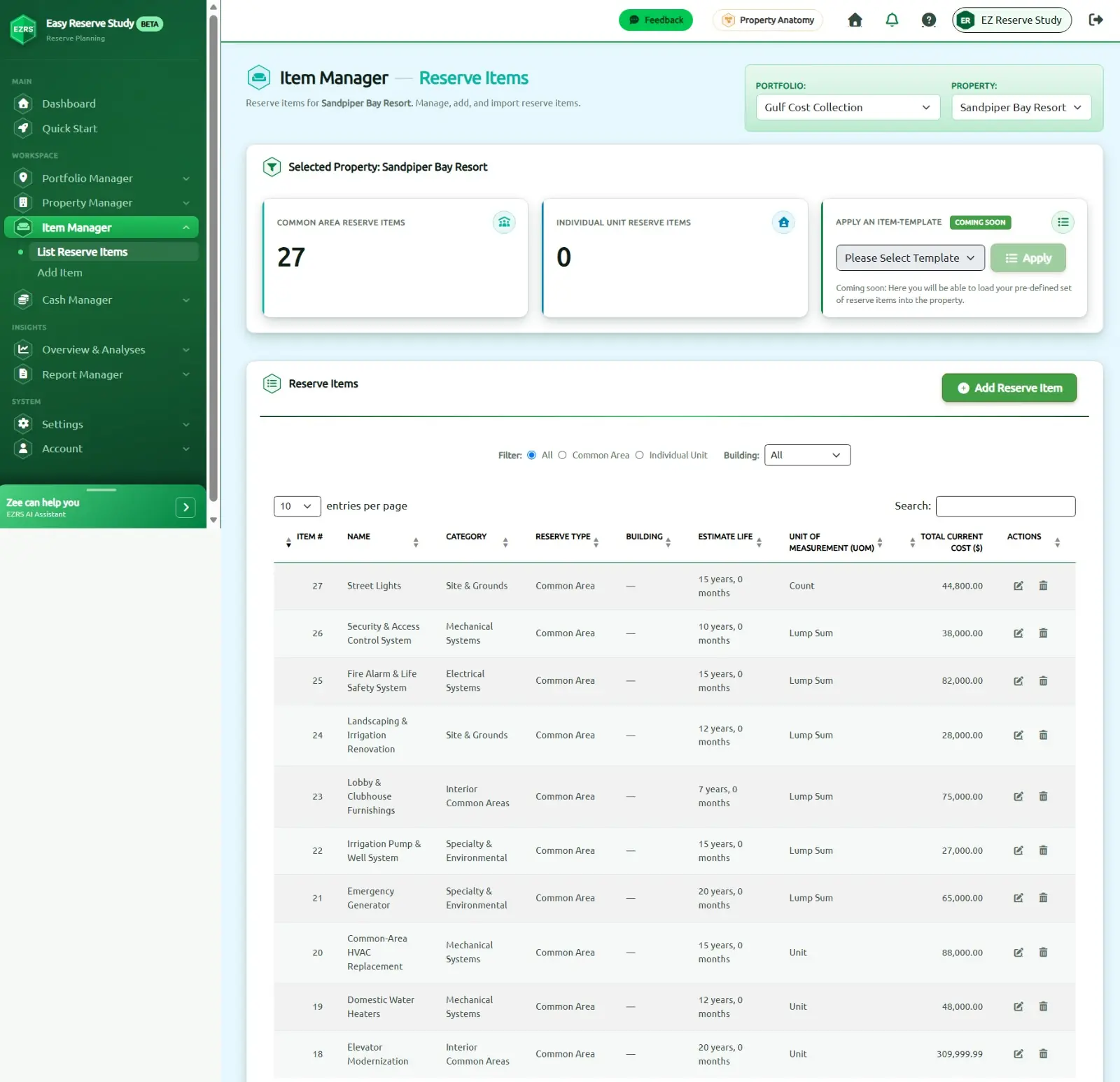
Before and after: private beta feedback even reshaped the interface itself. The change doesn’t touch how the product performs — it just makes the application a lot more inviting to work with.
Closing the Gap Between the Field and the Reserve Study Report
Some of the sharpest feedback from private beta had nothing to do with what’s inside EZRS. It was about everything that happens before data ever reaches the platform.
What got captured on-site and what made it into the report kept working across a gap. A specialist finishes a site visit with notes, photos, and measurements captured in the field — sharp, specific, and accurate in the moment. By the time that same information gets typed into a report hours later, back at a desk, some of that sharpness is gone. Details get reconstructed from memory instead of simply carried forward. That gap between the field and the desk was showing up in beta feedback constantly, and it was costing the one thing that actually matters most: the specialist’s own judgment, captured while it’s still fresh.
The fix was the EZRS mobile app — field notes now flow straight into the software, no gap in between.
Learn More About EZRS Mobile App
But the loudest request wasn’t about closing a gap in the present. It was about seeing further into the future.
Scenario Modeling for Reserve Fund Planning: What We’re Building Next
Fixing the field-to-report gap solved a timing problem. The next theme wasn’t about speed — it was about how far ahead a plan could see.
Scenario modeling came up in almost every conversation. Reserve professionals don’t just want to know where a fund stands today. They want to know where it could stand six months or two years from now, under a different contribution schedule. Is the fund on track between studies, or just assumed to be? Those aren’t hypothetical questions — they’re what decides whether a community faces a special assessment or avoids one.
We’re building the answer now: scenario modeling that lets someone plan a path from, say, 70% funded to 80% funded, and see exactly what it takes to get there. It isn’t live yet, but of everything private beta surfaced, it’s the one I keep coming back to — the difference between EZRS reporting where things stand and helping decide where to go next.
Why We’re Opening This Up Now
Private beta did exactly what it was supposed to do. It put real pressure on the product before the world was watching. Now we’re ready for more of that pressure, at scale. That’s why we’re opening EZRS to public beta.
That’s also why I’m starting something new: The Zee Log. Starting October 2, every two weeks on LinkedIn, I’ll post a real update on what we’ve learned and what we’ve built because of it. Not a polished recap. Not marketing copy. What’s actually changing, and why.
Join Us
If you’re a reserve professional firm, property management company, or capital management team, this is your moment to help shape what EZRS becomes. Join the public beta today . Once you’re in, you’ll find an active feedback button right in the app — use it. That’s exactly how NRSS alignment, categorization, and the mobile app made it into the product. Scenario modeling is next, and it will be built the same way: from real feedback, from real professionals, doing real work.
Don’t wait for the finished version — help us shape EZRS around the kind of work your firm actually does.
About Easy Reserve Study (EZRS)
Easy Reserve Study® (EZRS®) is AI-augmented reserve study software for smarter capital planning. Built for reserve management companies, independent reserve specialists, property managers, HOAs, vacation clubs, and institutional operators — EZRS replaces static spreadsheets and fragile manual processes with a continuously updated, living system of record.
We are building in active partnership with the reserve planning industry. If you are a reserve professional curious about what we are working on, we would welcome the conversation.


